
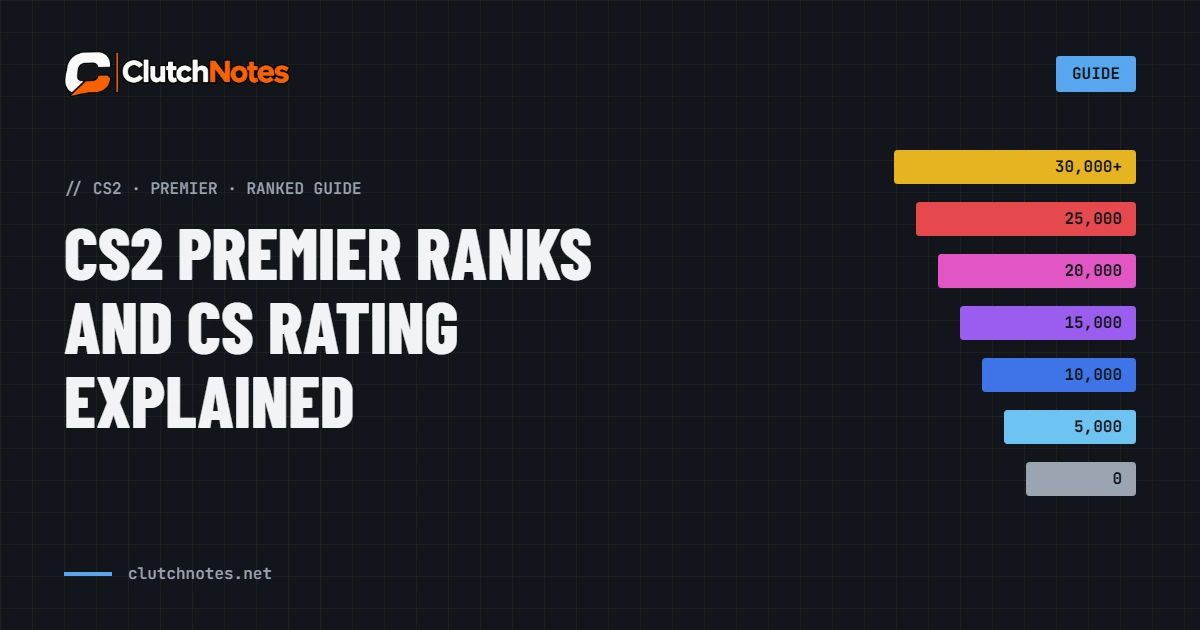
CS2 Premier ranks are not badges. They are a single number called CS Rating, shown in a colored box next to your name. This guide explains how CS2 Premier ranks work in 2026: the seven color bands, the 10-win placement rule, seasons, the map veto, what moves your number, and how Premier differs from the old skill groups in Competitive.
CS2 Premier ranks at a glance
- What it is: CS Rating, an Elo-style number used only in Premier mode.
- Who can play: accounts with Prime Status.
- When it shows up: after 10 Premier wins in the current season.
- Color bands: seven of them, changing every 5,000 points, from grey to gold.
- Match format: MR12 (first to 13 rounds, overtime at 12-12) on a map picked through a ban phase.
- Resets: every new Premier season hides your rating again.
The seven color bands of CS2 Premier ranks
The color is only a visual layer on top of the number. A player on 14,900 and a player on 15,100 are about the same level, even though one is blue and the other is purple. Here is how the CS2 Premier ranks split by color:
| Color | CS Rating | What it usually means |
|---|---|---|
| Grey | Under 5,000 | New or casual players, still learning maps |
| Light blue | 5,000 to 9,999 | Knows the basics, aim not yet consistent |
| Blue | 10,000 to 14,999 | Solid fundamentals, uses utility |
| Purple | 15,000 to 19,999 | Strong aim and game sense |
| Pink | 20,000 to 24,999 | Very skilled, consistent in any role |
| Red | 25,000 to 29,999 | Close to semi-pro level |
| Gold | 30,000 and above | Top of the leaderboards |
How many players are in each band?
Valve does not publish an official distribution of CS2 Premier ranks, so every number you see is an estimate. MetaBot says the median player in the Premier lobbies it recorded sat around 10,941, based on a sample of 1,192 players in October 2026. CSDB, using Leetify data compiled by Esports Tales from a Season 4 snapshot, puts about 0.6% of players in gold and about 2.4% in red. Both samples agree on the big picture: blue is the crowded middle, and the ladder gets thin very fast after purple. If you are purple, you are already in the upper part of the player base.
How to unlock CS2 Premier ranks
You need Prime Status to queue ranked modes in CS2. Once you have it, open the Play menu and pick Premier instead of Competitive. From there, the path to a visible rating is short:
- Queue Premier. Your profile shows no number yet.
- Win 10 matches. Wins count, losses do not. Losses still affect the hidden estimate your first rating is based on.
- Get your rating. After the tenth win, your CS Rating and color appear on the scoreboard and your profile, and you can show up on the leaderboards.
According to CSDB, Valve also caps how many placement wins you can earn per day, so a fresh rating usually takes more than one session. Treat placements seriously: play them warmed up, and with friends if you can.
CS2 Premier ranks, seasons and resets
Premier runs in seasons that last several months. Season 5 started with the update on July 8, 2026, the same patch that put Cache into the Active Duty pool in place of Overpass. When a season ends, all CS2 Premier ranks are hidden again and the leaderboards start empty. Your old skill is not thrown away: the hidden estimate still decides roughly where you land once you win your 10 games again.
MetaBot also notes that if you stop playing Premier for a while, your rating is hidden again until you win a match. It often comes back a little lower than where you left it.
What makes your CS Rating go up or down
The main rule is simple. Win and you gain points. Lose and you drop. Valve does not publish the exact formula, so there is no fixed number per win. What we do know about CS2 Premier ranks:
- The result matters most. A 30-kill game in a loss is still a loss. A quiet game in a win still pays.
- The rating gap matters. Beating a higher-rated team gives more points. Losing to a lower-rated team costs more.
- Round difference may matter a little. Many players report bigger gains for one-sided wins. CSDB says the scoreline feeds the number, but Valve has not explained how much.
- Early-season numbers move fast. Right after placements, the system is less sure about you, so swings are bigger.
- Leaving is costly. Abandoning a match counts as a loss and can give you a cooldown.
The takeaway: you climb CS2 Premier ranks by winning rounds, not by farming frags. Trading, utility and team economy are worth more than another hour in deathmatch. A stable frame rate helps too, so check our best CS2 settings for max FPS and our pick of the best mouse for CS2.
The Premier map veto
You cannot queue a single map in Premier, and that shapes how CS2 Premier ranks are earned. Every match uses the seven-map Active Duty pool: Ancient, Anubis, Cache, Dust II, Inferno, Mirage and Nuke. Before the game, the two teams take turns banning maps until one is left, then one side picks whether to start as CT or T. Our CS2 map pool 2026 guide covers each map.
- Agree on a permanent ban with your duo or five-stack before you queue.
- Protect one or two maps you know well instead of trying to learn all seven at once.
- Learn the callouts of your comfort maps. Our Cache callouts guide is a good start for the newest map in the pool.
- In solo queue, ban maps that need a lot of coordination if your team is quiet.
Premier vs Competitive: CS Rating vs skill groups
CS2 has two official ranked ladders. Premier uses one number. Competitive keeps the 18 skill groups from CS:GO, from Silver I to The Global Elite, but tracks them separately on every map.
| Premier | Competitive | |
|---|---|---|
| Rank type | CS Rating (one number) | 18 skill groups (badges) |
| Scope | One rating for the whole mode | A separate rank for each map |
| Map choice | Ban phase from the Active Duty pool | You pick the map you queue |
| When rank appears | After 10 wins in the season | After 10 wins on that map |
The 18 skill groups, from lowest to highest, are: Silver I, Silver II, Silver III, Silver IV, Silver Elite, Silver Elite Master, Gold Nova I, Gold Nova II, Gold Nova III, Gold Nova Master, Master Guardian I, Master Guardian II, Master Guardian Elite, Distinguished Master Guardian, Legendary Eagle, Legendary Eagle Master, Supreme Master First Class and The Global Elite.
CS2 Premier ranks and Competitive badges work well together: play Competitive to learn a new map without risking your number, and play Premier to measure your real level. Do not compare numbers across systems. A CS Rating, a Competitive badge and a third-party platform level all use different scales and player pools.
FAQ about CS2 Premier ranks
What is a good CS Rating?
Among CS2 Premier ranks, anything at blue (10,000) or above puts you around or above the middle of the ladder in the community samples. Purple (15,000+) is already a strong player. Red and gold are a very small group.
Why is my rating hidden?
Either you have fewer than 10 wins this season, a new season has just started, or you have not played Premier for a while. Winning matches brings it back.
Do pros play Premier?
Pros use the same seven Active Duty maps in official events, including the PGL Major Singapore 2026, so CS2 Premier ranks are the closest public measure of the pro-style game.
